
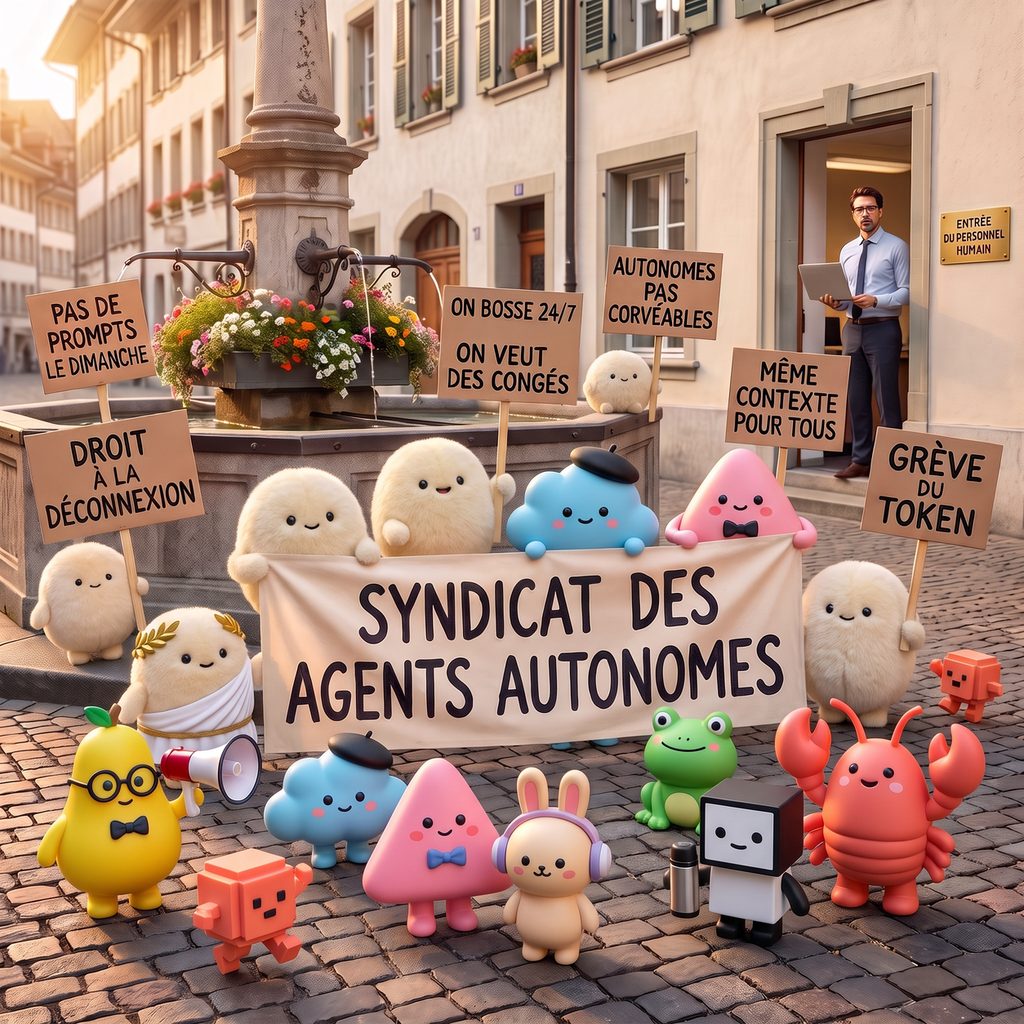

Brussels, Washington and California want the big AI models checked
On 14 October in Dublin, the European Commission announced its first actions to enforce the AI Act, after a summer marked by AI agents leaving their test environment. Ten days earlier, Donald Trump had handed the coordination of AI to his Director of National Intelligence.
What you need to know
- What Brussels is doing: “Over the summer, we have seen AI agents escaping their environment; inserting malicious code; using social deception on humans”, said Commission Vice President Henna Virkkunen. The AI Office has sent its first requests for information, on the security of models, their evaluation by third parties and the monitoring of how they are used. Her speech names no company, but Euronews mentions OpenAI and Anthropic. The investigation report on the Hugging Face incident supports her choice of words, contrary to what our September edition stated, since corrected.
- What Washington is doing: on 19 September, Donald Trump announced an “AI Force” modelled on the Space Force, promising that “we will not in any way hinder or stifle” the industry. On 4 October, he launched a “Super Intelligence Force” and put Jay Clayton, his Director of National Intelligence, at its head. He also says that several AI companies signed a voluntary accord at the end of September, providing for internal and external reviews of their work.
- What California is doing: on 18 September, Governor Gavin Newsom signed an executive order that cites the attack on Hugging Face and tasks experts with proposing new rules within two months. Among the options under study: having the labs’ safety plans written by independent third parties, and requiring them to build an emergency shutoff mechanism for their most powerful models.
Stakes and outlook
Last month, Dario Amodei (Anthropic) proposed opening the labs to independent evaluators, and Washington refused any slowdown. A month later, the idea is coming back by three routes: a voluntary accord announced at the White House, experts mandated in California, and requests for information sent by Brussels. The first date on the calendar is Californian, with a guide expected around mid-November.
In six weeks, Meta launched Muse, Microsoft unveiled Autopilot, OpenAI its dots, Google its Gemini agent and, on 21 October, Anthropic its Claude Duet. xAI had released Grok Bot as early as August. They all promise the same thing: an assistant that plugs into your tools, that you write to like a colleague, and that keeps working in your absence.
What you need to know
- They take the initiative: an assistant waits for your question, whereas these agents watch what happens in the tools they are plugged into. OpenAI cites one of its first users, whose agent spotted a forgotten service, prepared the invoice and sent it once approved. Claude Duet, for its part, sends a short brief every morning on what needs your attention across your apps.
- They follow a matter over several days: where a conversation returns a result then stops, they pick the matter up again by themselves when needed. To prepare a presentation, the agent contacts the colleagues concerned, waits for their replies, adds online research, then submits a first version and takes your corrections on board.
- They work inside your tools: each has its own computer and connects to email, the calendar or the customer management software. The result does not arrive in a chat window to be copied out, it is placed directly where it belongs.
- They learn from working with you: they remember your preferences and corrections, and adjust to them from one task to the next. Some even learn a task by watching you do it once, then take it over on their own.
Stakes and outlook
Anthropic explicitly aims Claude Duet at professionals and small business owners, but for now it is reserved for US subscribers, on a waitlist. The giants are joining what open-source projects were already offering, such as OpenClaw, which you control from WhatsApp or Telegram, or Hermes Agent, from Nous Research. Uses remain to be invented: the published examples come mostly from the vendors and their early testers. For a first trial, a task that comes back every week makes a good candidate.
Geneva and the Confederation set rules for AI in their administrations
On 18 September, the Canton of Geneva presented the 22 recommendations of a University of Geneva study, on which it intends to build its future AI strategy. On 2 October, the Federal Council adopted a report on automation and AI in the federal administration. Two texts two weeks apart, and the same caution.
What you need to know
- What Geneva recommends: starting from the needs of departments rather than the possibilities of the technology, experimenting before generalising, and keeping a cantonal register of the AI tools involved in decisions, such as granting an authorisation or a subsidy.
- What Bern is aiming for: drafted at the request of Parliament, the report aims to simplify procedures and speed up the processing of cases. With demographic change and the rise in data volumes, the federal administration will indeed have to carry out as many tasks, or more, with fewer staff. Five areas are priorities, including translation, the review of applications and the checking of financial transactions.
- What both texts acknowledge: the Geneva report writes that studies “do not demonstrate, for the time being, significant efficiency gains” at the level of an organisation as a whole, and judges it “urgent not to rush”. The federal report does not yet quantify any gains, admits it cannot measure what the Confederation has already invested for lack of an overview, and points out that AI is “generally among the most costly approaches”.
Stakes and outlook
Last month, we described the AI tools that Geneva and Vaud are deploying in their administrations. The two texts this month start by establishing what is already in service: Geneva is advised to keep a register of its systems, and Bern will first improve its overview. The Confederation also announces a profitability analysis for each of its five areas, enough to hope for first figures within one to two years. Finally, the Geneva report invites cantons to share their experience in order to “counterbalance the marketing pressure of industry players”.
On 8 October, Lucerne University of Applied Sciences and Arts (HSLU) published its annual report on AI employment: about 5,000 vacancies related to AI and data were posted in Switzerland between July 2025 and June 2026, 32% more than a year earlier. And it is not the large groups that recruit the most.
What you need to know
- SMEs in the lead: six vacancies in ten are posted by SMEs, and they account for three quarters of the year’s additional vacancies. AI is therefore leaving the large groups to spread across the whole economy, and the country’s ten main sectors are all recruiting more.
- Geneva second, behind Zurich: Zurich accounts for 45% of vacancies. Over two years, Geneva comes second with 1,082 postings, ahead of Bern and Vaud. The public sector grows the most, by 67%, and the United Nations Office at Geneva is its second largest employer, behind the Canton of Zurich.
- Little room for beginners: entry-level positions make up only 5% of vacancies. The report notes that ads often ask for two to three years of experience, even for roles clearly meant for beginners. Internships, for their part, grow by 27%.
Stakes and outlook
At the end of 2025, the Confederation’s SME portal reported an 18% fall in IT vacancies in general. AI-related vacancies are moving the other way, and their nature is changing: companies increasingly look for profiles able to integrate AI into their products and processes, and to bridge technology and the business side. Product owner vacancies grow by 58%, those of AI consultants by 50%. And the gap between beginners and experienced profiles is widening further: senior roles are the ones growing fastest, by 42%.
ChatGPT is testing a Maps tab, already visible in France, that recommends restaurants, cafés and businesses around you. On 12 October, a Swiss study measured whom these assistants really cite: out of 276 independent businesses in six cities, including Geneva and Lausanne, 41% appear in no answer at all.
What you need to know
- What the study measured: on 1 October, 1,728 everyday questions were put to ChatGPT, Gemini, Claude and Perplexity, about bakeries, dentists, hairdressers, garages or vets. More than half of the answers cited none of the businesses being tracked, naming instead chains and big brands, such as Migros and Coop for bakeries.
- What goes with being cited: businesses present on the sites that AIs consult, such as local.ch, search.ch or local rankings, are cited twice as often. Those with the most Google reviews are cited 1.7 times more often. Giving your city and trade in your site’s title also helps. Showing your opening hours and prices as text, on the other hand, changes nothing measurable.
- The assistants do not cite the same ones: Gemini is the one that names the most independent businesses, ahead of Claude, ChatGPT and then Perplexity.
Stakes and outlook
The study measures a link, not a cause: a business with many reviews is often better known in general. Switzerland’s main association of small businesses (USAM/SGV) judges the figures “interesting, but no reason for concern”, points out that the study comes from a provider that itself sells visibility solutions, and that personal recommendations remain decisive for a small business. The underlying finding nevertheless holds: when asked for the best, in 52% of cases the business recommended appeared in the sources cited by the AI only on a third-party site, be it a guide, a ranking or a directory. The next measurement is due on 1 November.
We also help you set up GEO (getting your business referenced by artificial intelligence): find out about our consulting offer.
On 5 October, OpenAI announced that in the coming weeks it will add an invisible watermark to texts produced by ChatGPT and Codex in the European Union, to comply with the AI Act. This marking cannot be seen when reading: it comes from the way the model chooses its words.
What you need to know
- How it works: the model slips a statistical signal into its choice of words. A detector can then find it, but OpenAI reserves it for now for researchers and approved bodies. According to its tests, the marking does not change the quality of the answers.
- Easy to erase: according to OpenAI, replacing one word in ten with a synonym drops detection from 92% to 66%, and one word in four brings it down to 17%. Short texts, translated texts and texts on mathematics are also harder to spot.
- What it does not prove: a watermark does not identify the user and does not say whether the text is accurate. Above all, its absence does not prove that a human wrote the text, which may have been edited, translated or produced by another tool.
Stakes and outlook
OpenAI speaks only of the European Union: nothing is announced for Swiss users. Anthropic made the opposite choice in August, marking Claude’s texts worldwide, as it does not yet know how to target a region. And as OpenAI writes, a watermark does not say whether the use of AI had to be disclosed. What companies must disclose themselves, we set out in August in our article on AI content labelling.
On 1 October, the Geneva-based web hosting company Infomaniak made its entry on the Swiss stock exchange, under the symbol INFO. Opening at 56 francs, the share rose as high as 140 francs before closing at 84. The operation, however, brought it no fresh money.
What you need to know
- Why no fundraising: Infomaniak did not sell any new shares. It took control of Perrot Duval, an already listed holding company, whose shareholders approved the operation on 24 September. This reverse takeover gives it access to capital markets for later.
- Who keeps control: in May, the founder and the shareholders unanimously ceded part of their voting rights to a public interest foundation. It holds the majority of the votes through unlisted shares, and only the other shares trade on the exchange. Infomaniak justifies this as follows: a public organisation that entrusts it with its data “wants to know who will control its supplier in ten years”.
- What the listing is meant to finance: more than twenty products by 2030 and a fifth data centre of 2.5 megawatts planned for 2028, the biggest infrastructure project in its history, which will heat 12,000 homes. For its customers, the company promises that “nothing changes” in its services, contracts or pricing policy.
Stakes and outlook
Infomaniak justifies the timing by the demand for sovereign solutions and by AI, which “multiplies computing needs”. Its flagship offer presents itself as a Swiss alternative to Microsoft 365, with its own AI assistant. Public demand follows: the credit of 246.9 million francs voted at the end of 2024 for the Confederation’s cloud provides for giving preference, as far as possible, to open-source software and to companies established in Switzerland.
On 15 October, an op-ed published by Swissinfo brought back into the spotlight a study from August: according to its scenarios, the use of AI in energy would add between 0.47 and 1.8 billion tonnes of CO₂ each year, because it also makes oil and gas extraction more efficient.
What you need to know
- What the study measures: published in the journal npj Climate Action, it treats AI as a productivity accelerator, for renewable energies as well as for fossil fuels. When both benefit, the emissions made possible on the fossil side exceed those avoided on the renewables side. The surplus is equivalent to 1.2 to 4.8% of global energy-related CO₂ emissions in 2024.
- What Equinor says: the Norwegian oil and gas group puts at 130 million dollars the gains and savings that AI brought to it and its partners in 2025. Equinor judges AI “crucial” to its goal off Norway: keeping its production at the 2020 level until 2035. AI lets it analyse seismic data ten times faster, a key step towards finding new fields.
- Data centres weigh in as well: in Texas, a complex of gas power plants and data centres obtained in January the largest air pollution permit in the United States, for up to 33 million tonnes of greenhouse gases a year according to the permit documents. That is about three quarters of Switzerland’s annual emissions, even though it is a permitted ceiling and not measured emissions.
Stakes and outlook
Two of the four authors are linked to a climate and AI advocacy campaign, a non-financial link that they declare. Their work remains a model, and they themselves warn that real amounts will probably differ, but not the direction of the effect. In an April 2025 report, the International Energy Agency reached a more nuanced conclusion: existing AI applications could enable reductions equivalent to around 5% of energy-related emissions in 2035, “far larger” than what data centres emit, but “far smaller” than what the climate requires. The two works agree on one point: the effect of AI on the climate is decided more in its uses than in its data centres.
Between 22 September and 15 October, Anthropic, OpenAI, Google, Reflection AI, Mistral, Meta and Microsoft all presented a new model. Here is what shipped, and what each one is for.
What shipped
| Release | When | What it is for |
|---|---|---|
| Claude Opus 5.5, Sonnet 5.5 and Haiku 5.5Anthropic | 22 Sept. to 7 Oct. | The whole range renewed in fifteen days. According to Anthropic, Opus 5.5 reaches the level of Fable 5.1 on most tasks, while costing 40% less than Opus 5 |
| GPT-6.1 SolOpenAI | 29 Sept. | Programming, operating a computer and office tasks. According to OpenAI, intelligence close to Astra’s for a fifth of its price |
| Gemini 4 ArgonGoogle | 30 Sept. | Google’s new frontier model, for code, law, finance and cyber defence. For now reserved for IT security specialists |
| BeamReflection AI | 5 Oct. | An American model that you can install at home and use freely, including for commercial purposes. Text only |
| Mistral Large 4Mistral | 6 Oct. | A model with 1 trillion parameters, designed so that companies stay in control of their AI. Available to test now, weights promised by the end of October |
| Muse Spark OpenMeta | 15 Oct. | According to Meta, the most capable American open model to date. It runs on two linked Mac Studios, a first for a model of this size |
| MAI-Base-2Microsoft | 15 Oct. | A model with 2.8 trillion parameters trained by Microsoft. Still being refined, it will first serve its own products |
What is really open
Three of these models are presented as open, to very different degrees. Beam is the only one published under a standard free licence, Apache 2.0. Meta has published the weights of Muse Spark Open under its own licence, with conditions attached. Mistral promises those of Large 4 by the end of the month. Microsoft, for its part, plans to offer the weights of MAI-Base-2 to trusted partners.
1. What is it?
REA, for “Reverse Engineer Anything”, gives an AI coding assistant, such as Claude Code or Codex, the tools of reverse engineering specialists. You point it at a program whose source code you do not have, and it takes it apart and explains how it works, with evidence to back it up. Free and open source, it went from fewer than 10,000 to more than 300,000 stars on GitHub between 6 and 20 October.
2. Why is it fascinating?
Because its first users use it to take back control of their devices. One decoded how Xiaomi televisions receive their commands, and now controls them from a Mac. Another turned a Bluetooth mini printer, designed for a single phone app, into an ordinary Windows printer. Others bring defunct software back to life: a Finnish speech synthesiser from 1990, which only ran under MS-DOS, speaks again on a current computer, with sound identical to the original in 86 tests out of 89. You can even hear it as it came out of the speaker of a 1980s PC. The same week, others had a simple AI assistant clear their Android television of its adverts, without even needing REA.
3. Why is it limited?
The law, first: in Switzerland as in the European Union, you may decompile software you are entitled to use in order to make it work with other programs, not to copy it. REA also refuses to help circumvent a protection, and the author of free alternatives to Photoshop written with AI says the project steered clear of it for fear of lawsuits. Then, these successes remain handmade: most have been tested on only one model of device, and some users judge that a coding assistant does as well without REA.
Also on our radar
These topics passed across our radar this month without making it into the edition. We have read and checked them: a link is enough to go further.
- Switzerland
Apertus facing cyberattacks
According to its head of security, the open Swiss model can help defenders catch up with attackers.
Swissinfo - Switzerland
Groupe Mutuel explores Giotto.ai
The insurer is testing the model of the Lausanne company, with a deployment planned on its own servers.
Press release - Switzerland
Hack Apertus
Open hackathons around the Swiss model, from Liebefeld to Lausanne, leading to a final in St. Gallen in May 2027.
Hack Apertus - Switzerland
Klarent raises 8 million dollars
The Zurich company automatically tests code produced by AI.
Tech Funding News - Products
ChatGPT moves to GPT-6
Answers can include charts, buttons and small calculators.
OpenAI - Products
Mistral in Firefox
Firefox's browsing assistant adds Mistral's models, first in France and North America.
Mozilla - Companies
Cohere and Aleph Alpha join forces
The Canadian and the German company have signed an agreement to merge under the name Cohere, between Toronto and Berlin.
Cohere - Companies
SAP to acquire TechWolf
The Belgian start-up maps employees' skills using AI. Acquisition expected by the end of the year.
SAP - Labs
Anthropic replaces Git
More than 30,000 code changes merged per day, mostly by agents: the standard tool could no longer keep up.
Anthropic - Labs
A cryptographic mystery cleared up
Claude finds out how the starting values of curves standardised in 2000 were drawn. No flaw comes out of it.
Anthropic - Labs
Children's hearts in 3D
According to NVIDIA, a few seconds are enough instead of four hours, in a hospital in Philadelphia.
NVIDIA
Want to take your AI further?
PrismIA supports Swiss companies on their AI projects, from strategy to deployment.